
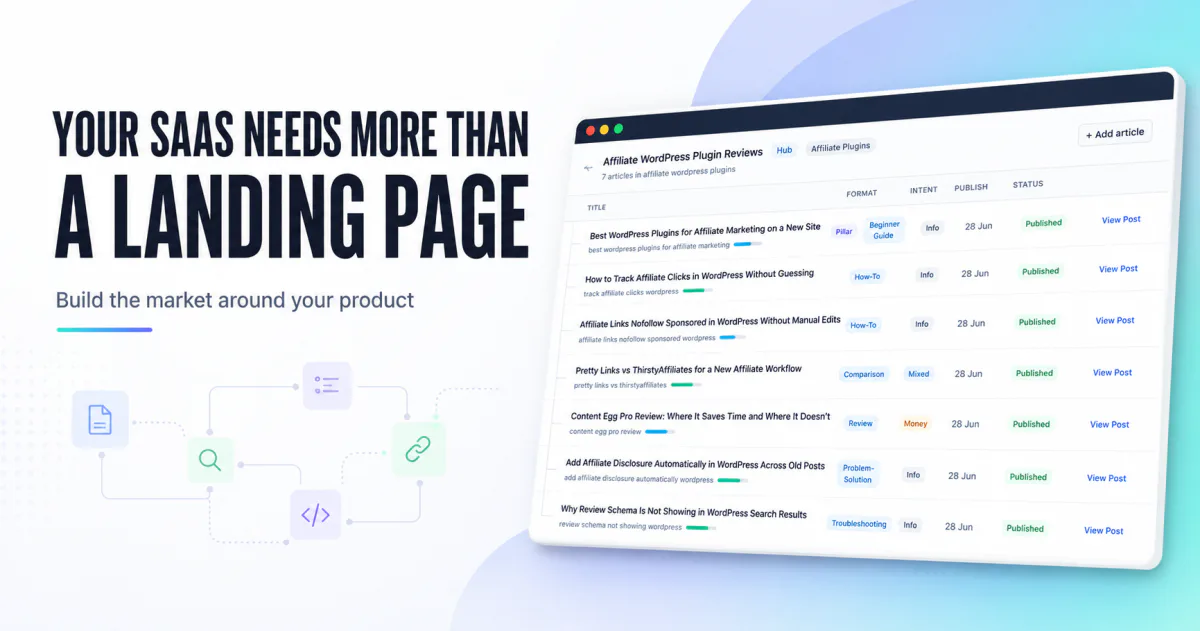
I recently created a new demo site for Too Much Niche:
BuildRankEarn.com
This demo is different from my previous hobby niche site.
That site was about microgreens and home fermentation. A real hobby topic. Something personal, practical, and easy to understand.
This time, I wanted to test a different use case: building a niche website around a digital product.
Not a classic affiliate niche site. Not just a blog. Not only a product landing page.
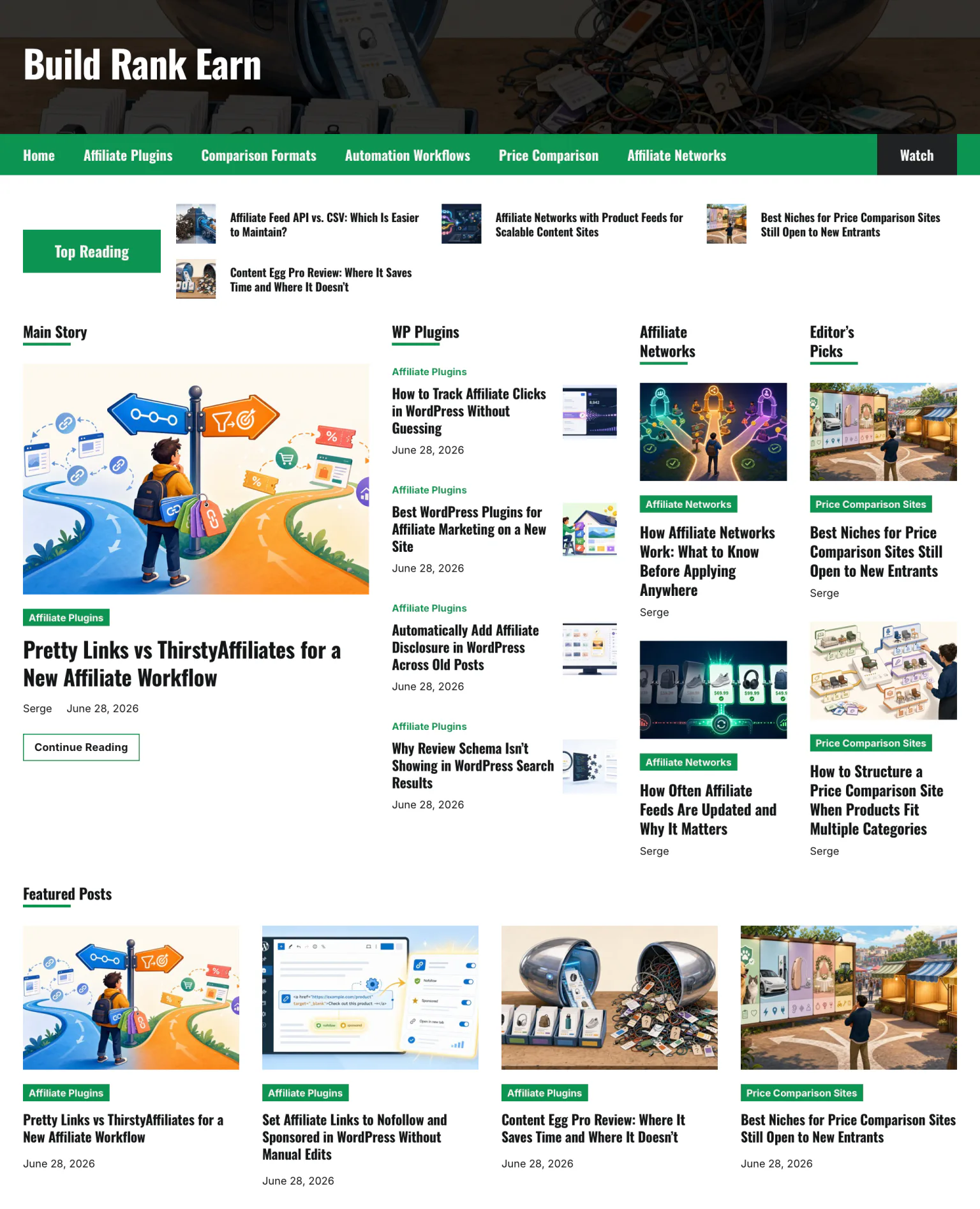
A real content site built around the market, problems, use cases, and buying context of a product.
For this demo, I used my own WordPress plugin, Content Egg Pro, as the example product. But the same strategy can work for many digital offers: SaaS products, WordPress plugins, courses, memberships, templates, API tools, Chrome extensions, AI tools, and small products built with vibe coding.
Because today, building the product is often not the hardest part anymore.
The harder question is:
How do people find it?
And even more important:
How do Google, AI assistants, and potential buyers understand what your product does, who it is for, and when it should be recommended?
That is what this post is about.
A landing page explains your product.
A niche website explains the market around your product.
And for many digital products, that second part is just as important.
First, the cold shower
You can build a SaaS or digital product faster than ever. With AI coding tools, vibe coding, templates, no-code tools, WordPress, APIs, and a hundred other shortcuts, creating the first version of a product is much easier than it was ten years ago.
That is good. But it also creates a new problem.
More people can build products now. More small SaaS tools. More AI wrappers. More WordPress plugins. More templates. More courses. More directories. More micro tools.
So the product itself is not always enough.
You can create something useful and still get almost no attention. You can build a clean landing page and still not rank. You can describe your features perfectly and still not reach people who actually need the product.
This is the part many indie hackers and vibe coders underestimate.
Shipping the product is not the end. It is the beginning of a new problem: discovery.
How will people discover the product? How will search engines understand the context? How will AI assistants know when your product is a good answer? How will buyers trust you if they only see one landing page and nothing else around it?
There is no magic here. A niche website will not bring traffic next week just because you published 30 articles.
Google needs time. Trust takes time. A new site needs review, improvement, links, examples, and patience.
But if you want to build a long-term discovery asset around your product, a structured niche site makes much more sense than publishing random blog posts whenever you feel inspired.
Why a landing page is often not enough
A landing page has one main job: explain the product and convert the visitor.
That is important.
A good landing page can show what the product does, who it is for, the main features, pricing, testimonials, FAQs, and a call to action.
You need this.
But a landing page is usually narrow. It talks mostly about the product itself.
And most buyers do not start there.
They often start much earlier. They search for the problem. They compare possible solutions. They look for alternatives. They try to understand which tool fits their use case.
They ask questions like:
- What is the best way to solve this?
- Do I need this type of tool?
- What are the alternatives?
- How does this compare to another product?
- Can I solve this inside WordPress?
- What should I use if I am a beginner?
- What is the cheapest way?
- What is the safer or more scalable way?
A landing page cannot answer all of that properly. If you try to put everything on one page, the page becomes messy.
So the problem is not that landing pages are bad.
The problem is that they are not enough.
A landing page explains your product. But a niche website explains the whole world around your product.
That is a big difference.
The product is not always the search query
This is very important.
People do not always search for your product name, especially if your product is new.
Nobody searches for a brand they do not know yet.
For example, with Content Egg Pro, people may not start by searching “Content Egg Pro.”
They may search for things like:
- how to monetize a WordPress blog
- best affiliate plugin for WordPress
- how to add product boxes to blog posts
- how to create product comparison tables
- how to build an affiliate site with WordPress
- how to compare prices from different stores
- how to display affiliate offers inside articles
- Amazon affiliate plugin for WordPress
- product feed plugin for WordPress
These are not all direct product searches.
Some are informational. Some are commercial. Some are beginner questions. Some are comparison questions. Some are problem-aware searches.
But all of them live in the same market.
And this is where a niche website helps.
Instead of only saying, “Here is my product,” you build content that explains the problem, the use cases, the tools, the workflow, the alternatives, the mistakes, the buying questions, and the context where your product makes sense.
That gives search engines more context. It gives AI assistants more context. And it gives potential buyers more confidence.
This matters even more in the AI search era
Search is changing.
People still use Google, of course. But they also ask ChatGPT, Perplexity, Gemini, Claude, Copilot, and other AI assistants for recommendations and explanations.
They do not always search with short keywords anymore. They ask full questions.
Something like:
“What is the best WordPress plugin to add affiliate product blocks to informational articles?”
Or:
“How can I build a niche site around my SaaS product?”
Or:
“What tools do I need to monetize a WordPress blog with affiliate offers?”
When AI systems answer these questions, they need context. They need to understand what products exist, what they do, who they are for, and how they compare with alternatives.
I do not want to overpromise here.
Publishing articles does not guarantee that AI assistants will recommend your product. That would be nonsense.
But if your product has only one landing page, there is not much context to work with.
If you have a structured site around the product, with guides, comparisons, FAQs, use cases, reviews, and clear internal links, you give search engines and AI systems much more information.
Again, no magic.
Just better context.
The vibe coding problem
This is why I think this strategy is especially interesting now.
Vibe coding makes product creation easier.
You can build a small SaaS, a plugin, a calculator, an AI tool, a Chrome extension, a template pack, a paid directory, or a small automation tool.
That is great.
But after the product exists, many people get stuck.
They have a domain, a landing page, a Stripe checkout, maybe a demo video, maybe a Product Hunt launch, maybe a few posts on X, and then silence.
The product may be useful. But the market does not know it exists.
And even if people see it, they may not immediately understand why they need it.
That is where content structure helps.
Not “content marketing” in the vague corporate sense.
I mean a real site structure around the product. A site that answers the questions your future customers already have. A site that explains the problem better than your landing page can. A site that gives your product a place inside the market.
The wrong way: random blog posts
Many product founders know they “should do SEO,” so they start a blog.
But usually it looks like this:
- one product update
- one generic how-to article
- one comparison post
- one founder story
- one AI-generated SEO article
- then nothing for three weeks
There is no structure.
No clear topical map. No planned internal links. No intent mix. No relationship between informational pages and product-focused pages. No reason why one article should exist before another.
This is the same mistake many AI niche sites make.
They generate a lot of articles, but the articles do not have a job.
More content is not automatically better.
More random content is just more mess.
The goal is not to publish more blog posts.
The goal is to build a structured content ecosystem around the product.
What a product-focused niche site should do
A product-focused niche site is not only a blog. It is also not only a sales funnel.
It is somewhere between education, SEO, product positioning, and trust building.
A good site around a digital product should help people understand:
- what problem the product solves
- who has this problem
- what alternatives exist
- when this product is useful
- when it is not useful
- how it compares to other options
- how to use it in real workflows
- what mistakes to avoid
- what results are realistic
- why the product is trustworthy
Some articles will be informational. Some articles will be commercial. Some will be mixed.
Some will mention the product directly. Some should not.
That last part matters.
If every article screams “buy my product,” the site becomes weak. A beginner guide should help beginners. A troubleshooting article should solve the issue. A comparison article can be more product-focused. A review article can include pricing, testimonials, and calls to action.
Different pages have different jobs.
This is why planning matters.
The demo: BuildRankEarn.com
For this demo, I created BuildRankEarn.com.
The idea behind the site is simple:
Build your site. Rank it. Earn from it.
The site is about website building, SEO, affiliate marketing, WordPress tools, and practical ways to create content assets around products.
For the example product, I used Content Egg Pro.
Content Egg is a WordPress plugin for affiliate product blocks, price comparison, product sections, offer lists, and monetization elements inside articles.
So instead of creating a landing page only for Content Egg Pro, I wanted to build a wider niche site around the market where Content Egg belongs.
That market includes topics like affiliate marketing, WordPress monetization, product comparison content, SEO content structure, affiliate product blocks, review articles, comparison articles, buying guides, and digital product promotion.
This gives the product more context.
The site is not just saying, “Buy Content Egg.”
It explains the market where Content Egg is useful.
That is the important part.
The basic setup
For the video demo, I started with a fresh WordPress installation.
Nothing special. No custom design. No complicated stack.
Just WordPress and two plugins:
In this setup, Content Egg is used to render article blocks, CTA blocks, pricing blocks, offer sections, and product-focused elements.
Too Much Niche is used to plan and generate the content structure.
This is important because the workflow is not:
“Ask AI to write 50 random articles.”
The workflow is:
- create the product profile
- create the niche site plan
- generate hubs and article ideas
- plan internal links
- define article intent
- generate content inside the structure
- review and improve it
That is a much better workflow.
Start with the Offer Profile
For a product-focused site, the AI needs to understand the product.
Not just the product name. Not just the homepage URL.
It needs real product context.
That is why Too Much Niche has an Offer Profile.
An Offer Profile contains important details about your product: positioning, features, pricing, plans, conversion URLs, testimonials, call-to-action links, discounts, trust signals, and other product information.
You can fill this manually.
But for the demo, I used AI to help.
The process is simple. Open your AI assistant and ask it to read your landing page and pricing page. Then give it the Offer Profile schema from Too Much Niche. Ask it to fill the schema based on the product information.
After that, copy the generated schema back into Too Much Niche and review it carefully.
Do not skip the review.
AI can misunderstand pricing. It can invent details. It can make the product sound more magical than it is.
So you still need to check the result.
But this saves a lot of time.
And once the Offer Profile is ready, it becomes the product memory for the site.
Why the Offer Profile matters
This is one of the most useful parts of the workflow.
Without a product profile, AI-generated content often becomes generic.
It may say things like:
“Use a powerful tool to improve your workflow.”
That is not useful.
With a proper Offer Profile, the content can include more specific product context. For example, what the product is, which users it helps, which features matter, what pricing options exist, which CTA link should be used, which testimonials can be shown, and which use cases are relevant.
It also keeps important product data separate from the article text.
That matters.
For example, if your product price changes, you do not want to manually edit 40 articles.
If pricing, discounts, testimonials, and CTA links are pulled from the Offer Profile, you can update the profile instead of regenerating everything.
That is much cleaner.
A product-focused site should not hardcode every commercial detail inside every article.
The article should explain the topic.
The product blocks should use current product data.
Create the site plan around the market, not only the product
After the Offer Profile is ready, the next step is to create the content plan.
This is where many people make the wrong choice.
They enter the product name as the niche.
But often, the niche should be the market around the product.
For my demo, I used:
affiliate marketing
Why?
Because Content Egg Pro belongs to the affiliate marketing and WordPress monetization market.
The product is Content Egg Pro. But the market is bigger.
That gives the site room to cover beginner guides, affiliate workflows, WordPress monetization, comparison content, product blocks, affiliate plugins, content structure, and product-focused SEO.
This is how you avoid creating a tiny blog with only product announcements.
You create a real niche site.
Of course, the niche should not be too broad either. If you choose “business” or “marketing,” the plan becomes too generic.
You want the market close enough to your product that the content can naturally support it.
Choose the right monetization strategy
In Too Much Niche, I selected the monetization strategy:
SaaS / Digital Products
This changes how the site is planned.
A site monetized with Amazon products is different from a site built around a SaaS offer.
A SaaS or digital product site needs different types of content. It needs more problem-solution articles, alternatives, comparisons, how-to guides, brand/product reviews, use-case articles, pricing context, trust-building content, and product CTAs.
The site is not only trying to insert products into articles.
It is trying to build a buying context around one offer.
That is why the monetization strategy matters.
Money, info, and mixed intent
A good product-focused site needs a mix of article intent.
Not every article should be commercial.
In the demo, Too Much Niche lets you choose the intent mix.
Money articles can promote the product more directly. These are good for comparisons, alternatives, product reviews, and commercial queries.
Informational articles are more useful for building topical authority and answering beginner or problem-aware questions. These should not be overloaded with sales blocks.
Mixed-intent articles sit between the two. They teach something useful but can also introduce your product when it makes sense.
This balance is important.
If the whole site is only money pages, it can feel thin and aggressive. If the whole site is only informational content, it may never guide readers toward the product.
You need both.
Plan scale and publishing horizon
For the demo, I selected a minimal plan.
About 30 to 60 articles.
That is enough to create a real structure without turning the project into something huge.
I also selected a four-month planning horizon.
This means the site does not need to publish everything on day one.
That is important.
Publishing 60 articles at once is not always the best workflow. It is better to have a plan, review content, improve important pages, and publish consistently.
A content site is not only a generation task.
It is an asset you maintain.
Hubs, pillar pages, and supporting articles
When the plan was ready, Too Much Niche created five hubs.
Each hub has a pillar page. The pillar page is the main guide for that topic.
Then each hub has supporting articles around it. Some are informational. Some are money or mixed-intent.
This is how a site starts to feel like a small library instead of a pile of posts.
A hub can cover one important area of the market. The pillar page explains the main topic. Supporting articles answer specific questions. Money pages handle commercial intent. Internal links connect everything.
This is the part most simple AI writers do not solve.
They can write one article.
But they do not always plan how that article fits into the whole site.
Every article needs a job
This is probably the most important point.
Every article should have a role.
One article introduces a topic. Another solves a problem. Another compares two tools. Another explains a workflow. Another supports a pillar page. Another moves the reader closer to the product.
If an article has no role, why publish it?
This is why I do not like the idea of generating hundreds of random AI posts.
It looks productive, but it often creates noise.
A planned site is different.
The content has internal logic. The links have a reason. The product mentions appear where they make sense. The site is easier for readers to navigate.
And it is easier for search engines and AI systems to understand.
Internal links should not be random
Internal linking is another part people often ignore.
They publish articles and then maybe add a few “related posts” links at the end.
That is better than nothing, but it is not real structure.
A product-focused niche site should use contextual internal links.
A beginner guide can link to a deeper tutorial. A comparison article can link to a product review. A pillar page can link to supporting guides. A use-case article can link to a relevant CTA page. A troubleshooting article can link to a solution article.
These links help users.
They also help search engines understand the relationship between pages.
In the demo, Too Much Niche plans internal links before content generation.
So when the articles are generated, the structure is already inside the content.
That is much better than trying to patch everything manually later.
Product CTAs should match the article context
One thing I showed in the video is how CTAs can work inside money and mixed-intent articles.
For example, one generated article compared two affiliate plugin competitors.
Inside that article, Too Much Niche added a CTA block for Content Egg.
But the CTA was not random.
It matched the article context.
That is important.
A CTA should not feel like an ad dropped into the middle of unrelated content.
It should appear where the reader has a reason to care.
For example, if the article is about affiliate plugin alternatives, a Content Egg CTA makes sense. If the article is about how to add product boxes to WordPress posts, a Content Egg CTA makes sense. If the article is a beginner guide about what affiliate marketing is, maybe the CTA should be softer.
Different intent, different CTA.
This is how product-focused content should work.
Pricing blocks and testimonials should be reusable
Another useful part of the demo was the generated Content Egg review article.
The article included a pricing block, promotions, trust signals, and CTA links.
But not all of that information was hardcoded inside the article.
Important commercial data can come from the Offer Profile.
This is a much better approach because product data changes.
Prices change. Discounts change. Testimonials change. CTA links change.
If all of this is buried inside article text, maintaining the site becomes painful.
But if the content uses structured product blocks connected to the Offer Profile, updates become easier.
This is especially useful for SaaS and digital products.
Your product will evolve. Your plans may change. Your positioning may improve. Your best testimonial today may not be your best testimonial in six months.
So the content system should allow updates.
This is not only for WordPress plugins
I used Content Egg Pro because it is my own product and it fits the demo well.
But this strategy is much broader.
You can use the same approach for many types of digital offers.
For a SaaS product, build content around the problem your software solves.
For a course, build content around the skill your students want to learn.
For a membership, build content around the community topic and ongoing pain points.
For a template pack, build content around use cases, workflows, examples, and comparisons.
For an API tool, build content around developer problems, integrations, and implementation guides.
For a WordPress plugin, build content around the use cases where the plugin helps.
The format changes.
The strategy is the same.
Do not only build a landing page.
Build the market around the offer.
Examples of useful article types
For a SaaS or digital product niche site, you can create many article types.
Not all at once. Not randomly. But as part of a plan.
For example:
- beginner guides
- how-to articles
- problem-solution posts
- comparison articles
- alternatives pages
- product reviews
- use-case tutorials
- integration guides
- pricing explainers
- mistakes to avoid
- FAQs
- case studies
- buyer guides
For Content Egg Pro, this could include articles like:
- how to monetize a WordPress blog with affiliate product blocks
- best WordPress affiliate plugins
- Content Egg review
- Content Egg alternatives
- Pretty Links vs ThirstyAffiliates
- how to create product comparison tables in WordPress
- how to add affiliate product boxes to blog posts
- product feed vs API for affiliate websites
- how to build a niche affiliate site around a digital product
Some of these articles attract early-stage readers. Some attract buyers. Some build topical authority. Some support the main product pages.
Together, they create a content ecosystem.
The site should support the product without becoming fake
There is one trap here.
When you build a site around your own product, it is easy to make every article biased.
That is bad.
You still need to be useful. You still need to explain alternatives honestly. You still need to admit when your product is not the best fit. You still need to write for the reader first.
For example, Content Egg is not the right tool for every affiliate website.
Some users need simple cloaked links only. Some need a full WooCommerce import system. Some need a custom integration. Some need manual product boxes. Some do not need a plugin at all yet.
That is fine.
A trustworthy product site should not pretend that one product solves every problem.
It should help the buyer understand when the product fits.
That creates better content.
And honestly, better customers too.
What you have after building this kind of site
After creating a site like BuildRankEarn.com, you do not just have a few blog posts.
You have a foundation.
You have a WordPress site, a product-focused content plan, hubs, pillar pages, supporting articles, money pages, mixed-intent articles, planned internal links, CTA blocks, pricing blocks, testimonials, product review content, and a publishing structure.
That does not mean traffic appears immediately.
It does not mean sales appear automatically.
It means you now have something to build on.
You can review the articles. You can improve weak sections. You can add screenshots. You can add real examples. You can update the Offer Profile. You can monitor Search Console. You can expand hubs that start getting impressions. You can create more comparison pages. You can improve CTAs based on real data.
The site exists after setup.
The asset grows after that.
Why I like this approach
I like this approach because it matches how real product discovery works.
Most people do not wake up and search for your product name.
They have a problem first.
Then they search. Then they compare. Then they ask questions. Then they look for proof. Then maybe they buy.
A landing page catches people near the end.
A niche website can help much earlier.
It can meet people while they are still learning the market.
That is useful for SEO. It is useful for AI search. And it is useful for trust.
Not because the site tricks anyone.
But because the site explains the topic properly.
Final thoughts
Vibe coding makes it easier to build products.
But products still need discovery.
A landing page is important, but for many digital products it is not enough.
If you want Google, AI assistants, and potential buyers to understand your product, you need more than feature lists and pricing tables.
You need content around the market:
- the problems
- the use cases
- the alternatives
- the comparisons
- the buying questions
- the workflows
- the trust signals
Not random blog posts.
A structured content ecosystem.
That is what I wanted to show with BuildRankEarn.com.
A SaaS, plugin, course, template, membership, or digital product should not live alone on one landing page.
Build the market around it.
That is where long-term discovery can start.
Ready to try it?
If you want to build this kind of product-focused niche site, Too Much Niche can help you plan the structure first.
Not just one article.
A full site plan with hubs, pillar pages, supporting articles, internal links, money pages, mixed-intent content, CTAs, pricing blocks, testimonials, and product-focused sections around your offer.
You can see the demo site here:
BuildRankEarn.com
And if you already have a SaaS, WordPress plugin, course, template pack, membership, or another digital product, this is the strategy I would test:
Do not only build a landing page.
Build the niche site around the product.

With 20 years in affiliate marketing, Serge creates practical WordPress tools such as Content Egg and External Importer that help publishers manage and grow their affiliate sites.