
Search has quietly changed its unit of measurement.
For twenty years, the page was the thing that ranked. Today, the thing that gets surfaced is often much smaller: a paragraph, a list, a table row, an FAQ answer, or a short verdict pulled directly from your article.
Google AI Overviews, Perplexity, ChatGPT with browsing, voice assistants, and featured snippets all work this way. They do not always need your whole article. They need the most useful, self-contained chunk.
That is a major shift for publishers, affiliate marketers, and review sites.
If your content is still written as 2,000 words of flowing prose, search engines and AI assistants have to work harder to understand where each answer begins and ends. But when your content is broken into labelled, structured, schema-ready sections, it becomes easier to extract, cite, rank, and reuse.
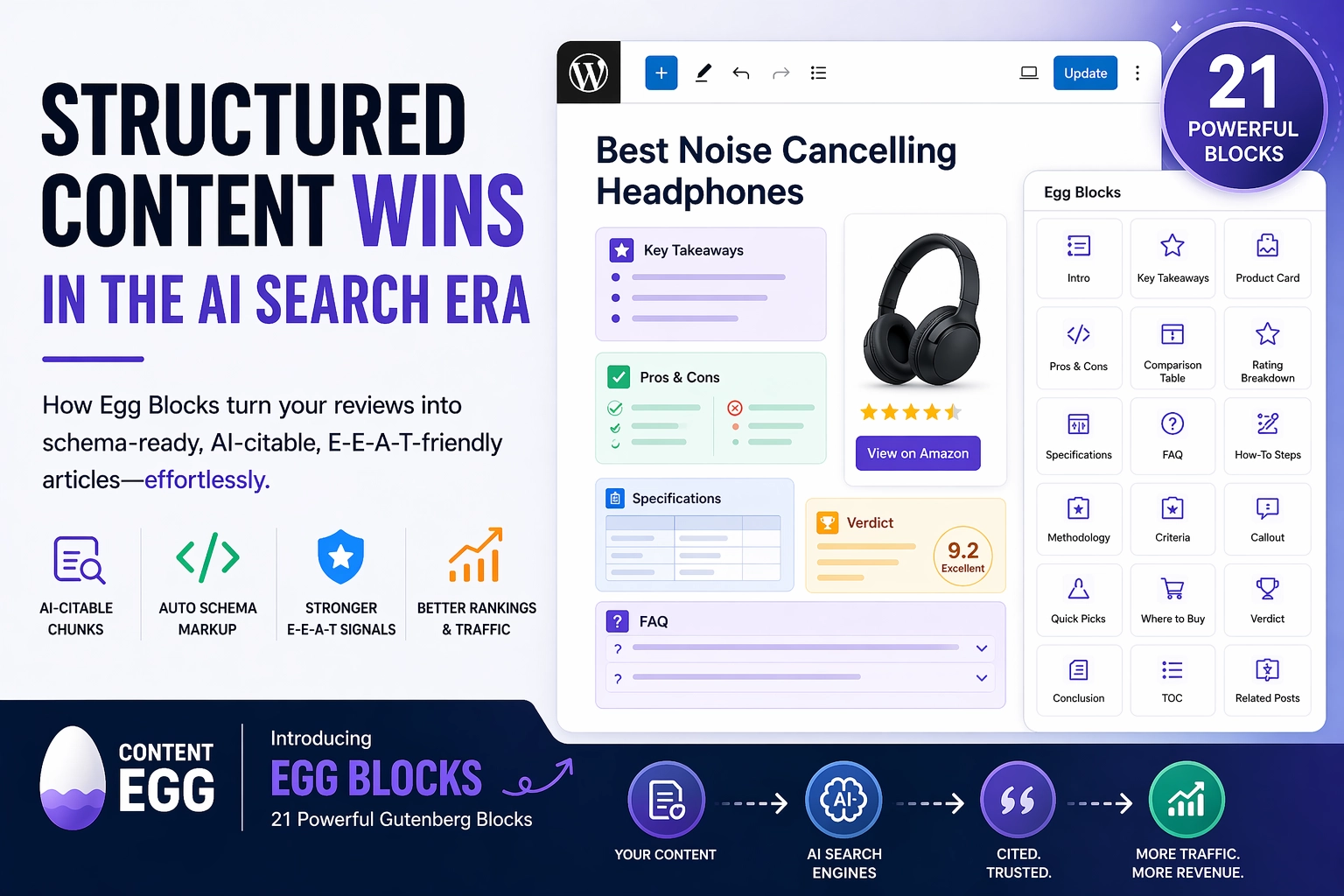
That is exactly why we built Egg Blocks — a set of 20+ Gutenberg blocks introduced in Content Egg v20.
This post explains why structured content beats traditional prose in the AI-search era, how it supports Google’s E-E-A-T expectations, and how Egg Blocks make structured, AI-citable content effortless to create.
How search changed: from pages to passages
Ten years ago, a strong SEO article was usually a single well-written page with a keyword in the title, a clear H1, and enough depth to outperform competing pages.
The page was the unit.
You ranked the page, or you did not.
That model has changed.
Modern search systems increasingly extract and surface smaller parts of a page:
- Google AI Overviews generate summarized answers and cite specific passages from selected sources.
- Perplexity builds answers with citations that point to individual supporting sections.
- ChatGPT with browsing may quote or summarize specific answer snippets from a source.
- Voice assistants often read one concise answer aloud.
- Featured snippets have rewarded passage-level content for years.
The pattern is clear: search engines and AI assistants do not always surface the whole article. They extract the smallest reliable passage that answers the query.
If your article is built from clearly labelled, self-contained chunks, you make that extraction easy.
If your content is a wall of prose, the AI has to guess where the useful answer starts and ends. Often, it will choose a competitor whose content is easier to parse.
What Google’s E-E-A-T actually rewards
E-E-A-T — Experience, Expertise, Authoritativeness, and Trustworthiness — is not just a vague quality concept. For affiliate and review content, it shows up through concrete signals.
The most important signals include:
- A clear methodology explaining how products were evaluated
- Specific evaluation criteria
- Author context and hands-on experience
- Structured data that helps search engines understand the content
- Clear verdicts and recommendations
- Update dates and signs of ongoing maintenance
- Original analysis that goes beyond recycled product specs
Notice the pattern.
Each of these signals works best when it is visible and labelled.
A methodology section. A criteria block. A verdict. A rating breakdown. A dated update note. A product specification table. A pros-and-cons section.
Traditional prose can include all of these things, but it often hides them inside paragraphs. Structured content surfaces them clearly for both readers and machines.
That is why the same structure that helps with E-E-A-T also helps with AI citations. Both depend on the same thing: making meaning easy to identify.
Why structured content beats plain prose
Structured content wins because it makes every important part of the article easier to understand, extract, and trust.
First, structured blocks give each section a clear meaning. A pros-and-cons block is not just text — it is a trade-off analysis. A rating breakdown is not just an opinion — it is an evaluation framework. A comparison table is not just formatting — it is structured decision data.
Second, each block can act as a self-contained answer. An FAQ item can answer a long-tail search query. A key takeaway can become a citation. A comparison row can answer an “X vs Y” query. A verdict can answer whether a product is worth buying.
Third, structured content supports schema markup. FAQPage, Product, Review, and HowTo schema are easier to generate when the content is already organized into clear blocks.
Fourth, structured content makes E-E-A-T signals visible. If every review includes methodology, criteria, verdicts, and rating breakdowns, your site builds a consistent quality pattern across many articles.
Finally, structured content improves the reader experience. Visitors can scan faster, compare products more easily, and find the answer they came for without digging through long paragraphs.
Better structure helps machines. It also helps humans.
Introducing Egg Blocks
Content Egg v20 includes 20+ Gutenberg blocks built around this exact idea.
Egg Blocks help you turn ordinary affiliate and review content into structured, schema-ready, AI-friendly articles without manually writing schema markup or designing custom layouts.
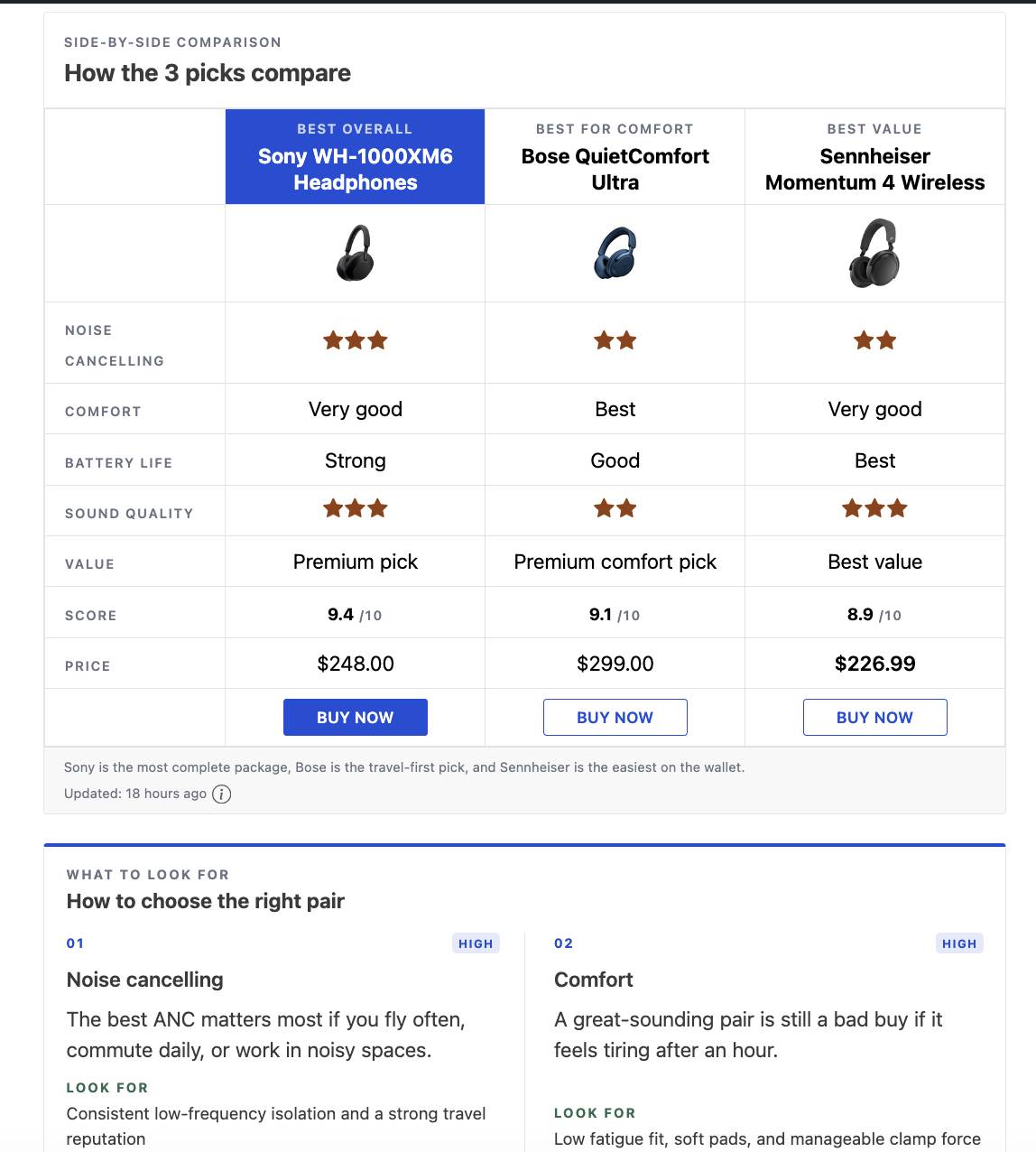
The blocks are grouped into four editorial categories:
Article structure
- intro
- conclusion
- section-header
- toc
- faq
- callout
- step-list
Editorial insights
- key-takeaways
- criteria
- methodology
- definitions
- myth-fact
- pros-cons
Product and commerce
- product-card
- quick-picks
- where-to-buy
- comparison-table
- verdict
- rating-breakdown
- specifications
Navigation
- related-posts
Every block follows one design system and respects your global color scheme. Product-focused blocks can also pull live prices, stock status, and affiliate URLs from your Content Egg products automatically.
You write the editorial content. Content Egg handles the structure, presentation, and commerce data.
But the real value is not just that the blocks look good.
The real value is that each block maps to a specific SEO or AI-search signal.
How each Egg Block maps to an SEO signal
Each Egg Block is designed to make a specific type of information clearer to readers, search engines, and AI assistants.
| Block | What it surfaces | SEO payoff |
|---|---|---|
| faq | FAQPage structured data and labelled Q&A pairs | Helps with FAQ-rich results, voice answers, and AI citations |
| methodology | Your evaluation process | Strong E-E-A-T signal for reviews and roundups |
| criteria | Your scoring or decision framework | Supports review quality and transparency |
| pros-cons | Clear trade-off analysis | Useful for “is it worth it?” and comparison queries |
| rating-breakdown | Category scores and overall rating | Supports review schema and star-rating eligibility |
| specifications | Structured product attributes | Helps with product-rich results and technical searches |
| key-takeaways | Short, quotable summary bullets | Easy for AI Overviews and answer engines to cite |
| verdict | Clear recommendation and score | Strong trust signal and answer-ready summary |
| comparison-table | Side-by-side product comparison | Useful for “X vs Y” and “best N” searches |
| quick-picks | Ranked shortlist | AI-friendly recommendation format |
| toc | Anchor links to article sections | Improves navigation and section-level relevance |
| intro | Clear article framing | Gives AI systems context for the page |
| conclusion | Explicit summary | Creates a clean final answer chunk |
In other words, each block is a pre-built answer format.
When you stack these blocks inside one article, you increase the number of useful chunks search engines and AI assistants can understand, extract, and cite.
Before and after: the same review, restructured
Imagine you are publishing a review of a pair of headphones.
The traditional version might look like this:
One article. Around 2,000 words of flowing prose. Brand background near the beginning. Product specs somewhere in the middle. Personal impressions scattered across several paragraphs. A recommendation buried near the end. No FAQ. No clear schema beyond the basics.
Google sees one page. AI systems see no obvious answer chunks. Rich result opportunities are limited. E-E-A-T signals are present, but hard to detect.
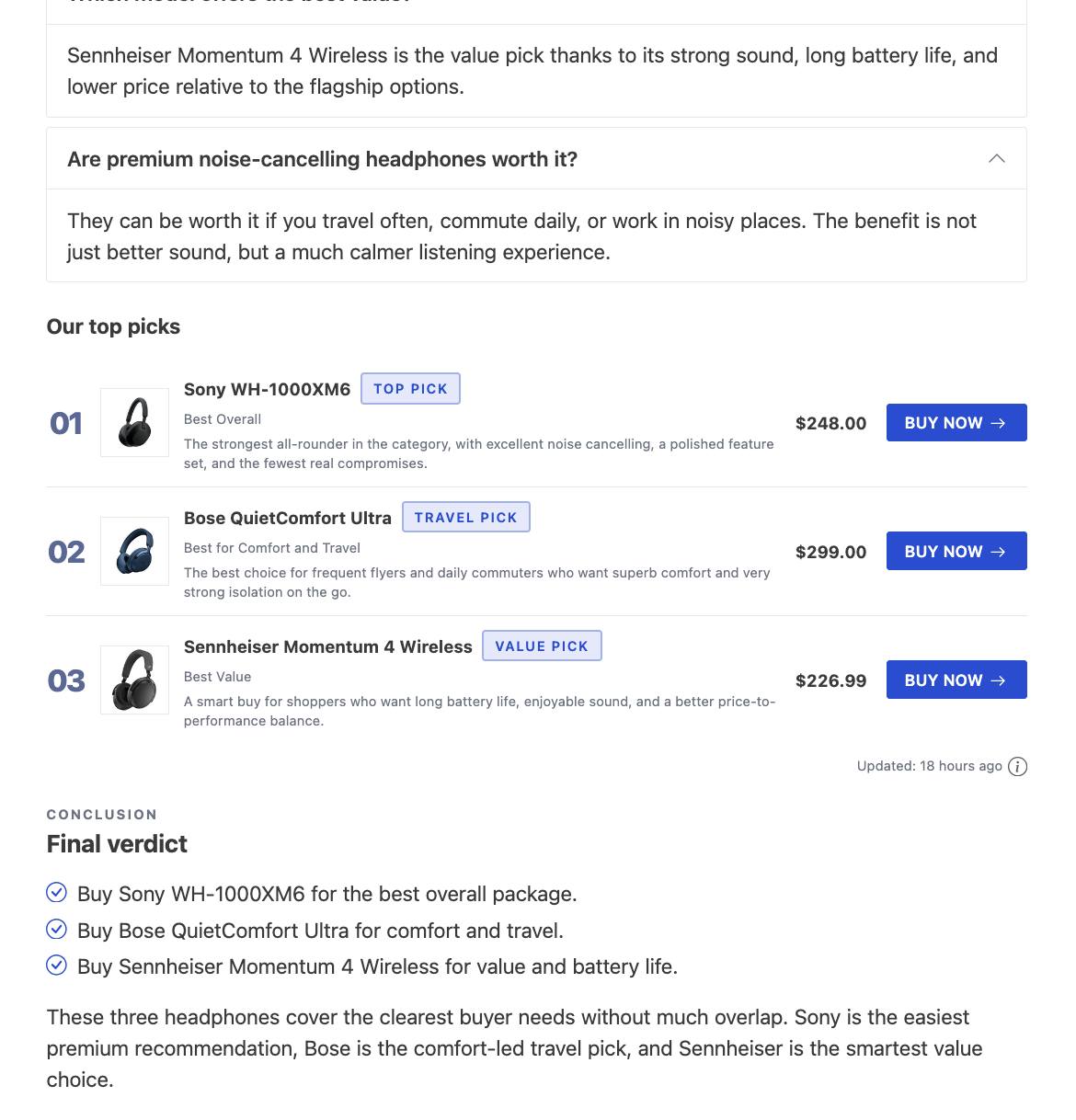
Now compare that with an Egg Blocks version:
intro → key-takeaways → product-card → specifications → pros-cons → rating-breakdown → methodology → verdict → faq → conclusion
The information is mostly the same.
But the structure is completely different.
Google can understand the product data, review data, FAQ content, and article sections more clearly. AI systems get multiple self-contained chunks they can cite. Readers can scan the review quickly and make a decision faster.
The article becomes more useful without becoming longer.
That is the power of structure.
AI can write in Egg Blocks format too
Structured content used to have one downside: it took more time to create.
Egg Blocks solve part of that inside WordPress. But you can also generate structured drafts with AI.
The EggBlocks Writer is a skill file you can paste into ChatGPT, Claude, or another capable AI assistant. After the AI reads it, you can ask for a full article — a single-product review, a roundup, a buying guide, or a comparison post — and get ready-to-paste Gutenberg markup using real Egg Blocks.
Then you drop the content into WordPress, assign your Content Egg products to the product blocks, review the article, and publish.
This creates consistency at scale.
Every AI-assisted article can follow the same structured pattern:
- clear intro
- key takeaways
- product cards
- comparison tables
- methodology
- criteria
- verdicts
- FAQs
- schema-ready sections
That consistency matters. It helps every article on your site send stronger E-E-A-T signals and gives AI search systems more clean chunks to work with.
Getting started with Egg Blocks
You do not need to restructure your entire site at once.
Start with the blocks that offer the biggest SEO payoff for the least effort:
- Update to Content Egg v20 from your WordPress dashboard.
- Open an existing review or roundup post.
- Add an intro block to frame the article clearly.
- Add key-takeaways near the top for fast, quotable summaries.
- Add an faq block to target long-tail questions.
- For product reviews, add pros-cons, rating-breakdown, specifications, and verdict.
- For roundups, add quick-picks, comparison-table, and where-to-buy blocks.
Once you are comfortable, use the composition recipes in the Egg Blocks documentation or generate a full structured draft with the EggBlocks Writer.
The chunk-based web is already here
Google AI Overviews did not wait for publishers to restructure their content. They already summarize and cite chunks from the pages that are easiest to understand.
Perplexity, ChatGPT, voice assistants, and other AI search tools follow the same pattern.
The publishers who adapt first will have an advantage. They will not just have better-looking articles. They will have content that matches how search actually works now.
Structured content is no longer just a design choice.
It is an SEO strategy.
Egg Blocks make that strategy practical. They help you turn reviews, roundups, and buying guides into clear, schema-ready, AI-citable content without custom development or manual markup.
Update to Content Egg v20, add your first Egg Block, and start publishing content built for the search era we are already in.

With 20 years in affiliate marketing, Serge creates practical WordPress tools such as Content Egg and External Importer that help publishers manage and grow their affiliate sites.