
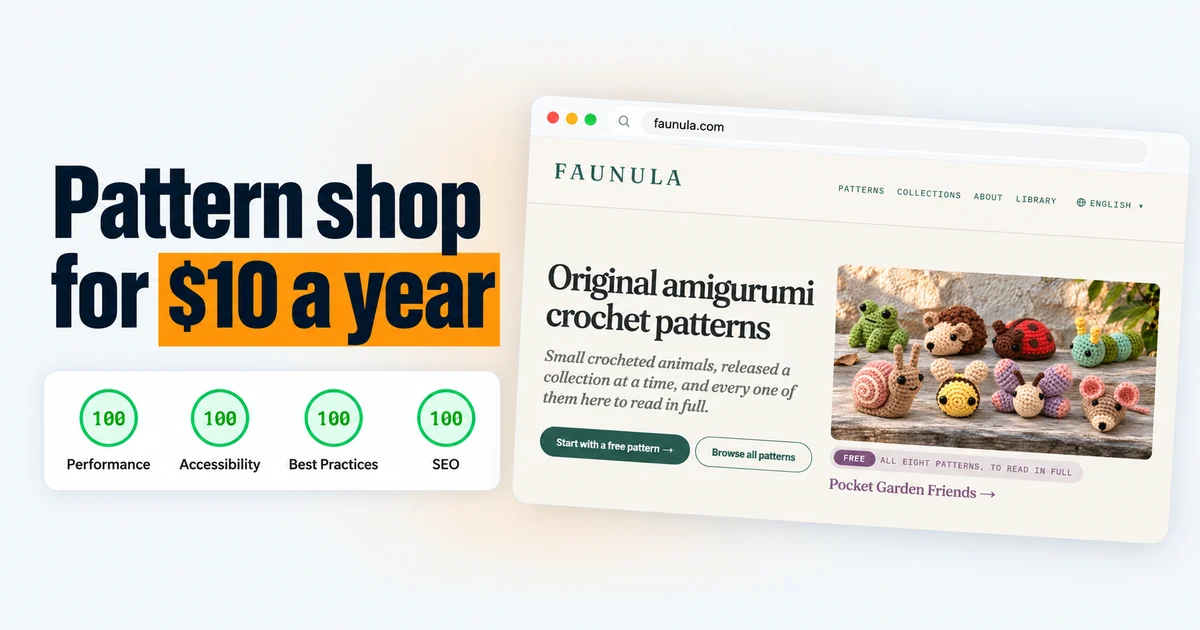
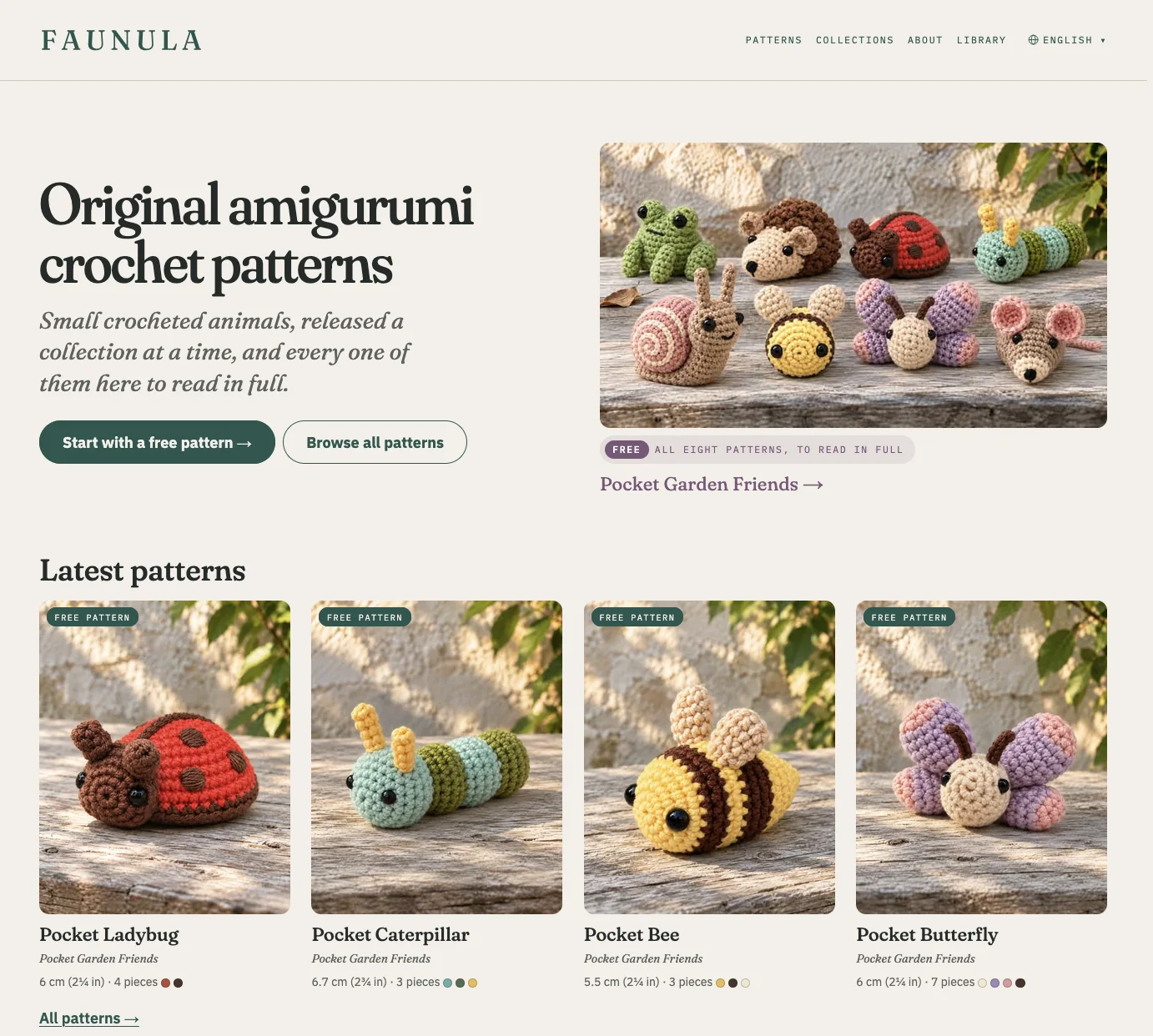
I design small amigurumi animals: a frog, a hedgehog, a ladybug, a snail with a spiral shell. The usual place to sell patterns like these is a marketplace such as Etsy. I wanted a shop of my own as well, so I built Faunula, my amigurumi crochet pattern shop, on a static site that costs me about $10 a year to run.
Written in October 2026. Prices and free-plan limits below are as of that month.
This post is about why I chose my own site, why a static one, what it costs and how fast it turned out. Serge and I run our IT business together, and his blog is read by people who run WordPress sites, so it seemed a good place to tell it.
Why my own site, and not only a marketplace
When you pay for ads on a marketplace, or send your Instagram followers to your shop there, you are mostly promoting the marketplace. The buyer remembers “I found it on Etsy”, and the next listing they open shows them other shops’ patterns next to yours.
The rules also belong to the platform. They keep changing, and a shop can be suspended overnight, with all its reviews and sales history attached to it. I didn’t want everything I build to depend on a policy page I don’t control.
I still use Ravelry, just differently. A pattern listing there can link to my own site, so it works as a shop window that sends people to me.
The downside is real. A marketplace brings buyers on day one; a new site starts with zero visitors, and you have to bring them yourself, with Pinterest and an email list. I think that work is worth it, because what it builds stays with you, but it is slower.
Back to plain HTML pages
The part that surprised me most: the web started with static HTML pages, and after years of databases and page builders, here I am, back to static pages.
A static site is a folder of finished pages. Nothing is assembled when a visitor opens one: no database query, no plugin to run. The pages are built ahead of time, uploaded to a CDN, and served from the server nearest to the reader. Faunula isn’t static all the way through. The newsletter sign-up, the checkout notifications from Paddle, and the library where buyers download their PDFs run as small functions on Cloudflare, with a small database for subscribers and orders. Every pattern page, though, is a finished file.
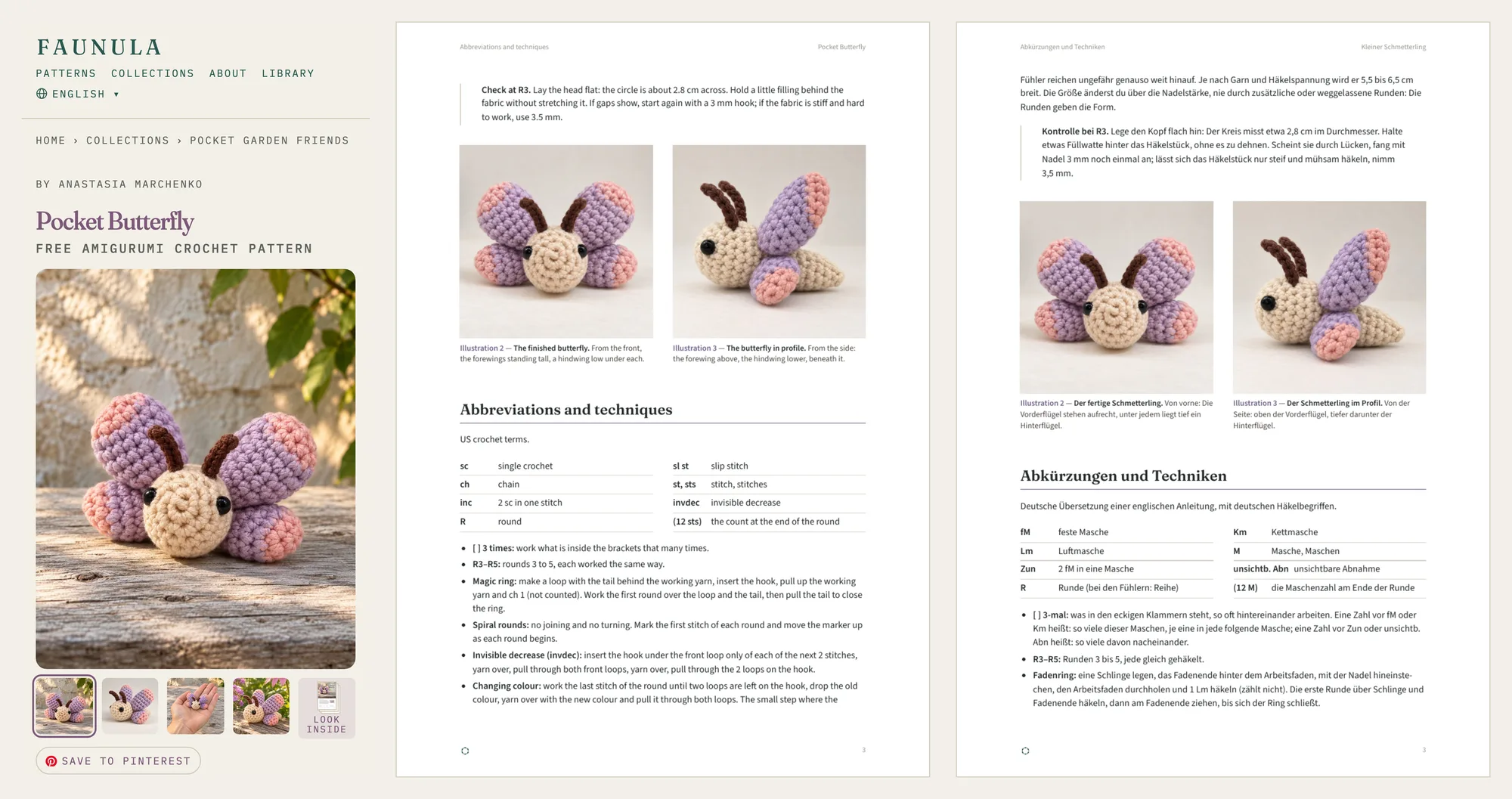
That fits a pattern shop well, because a crochet pattern is data. It has materials, a gauge, a finished size, and rounds with stitch counts that have to add up. I keep each pattern in one place, with every round and stitch count stored as data. From that source the build makes the free web page, the printable PDF, and seven language editions, including separate US and UK crochet terms. When I fix a stitch count, I fix it once, and every page and every PDF picks it up on the next build. The site itself is built with Astro, which turns those files into plain HTML.
I wouldn’t recommend this for everything. If you run a blog or an affiliate site, publish every day, and rely on plugins for product boxes and comparisons, WordPress is still the better tool, and this blog runs on it. A static site works best when the content is structured and changes in batches, like a catalogue or a shop with your own products.
No admin panel
Faunula has no CMS and no admin panel. I manage it through an AI agent. I tell it what to change, in text or by voice, or I give it a scan or a photo of a document. That could even be a pattern written on a napkin: the agent turns it into the structured data the pages are built from.
Once I filled in paper briefs for a pattern by hand and photographed them, and the agent read them and applied the changes to the pattern.
Nothing goes live without checks. Every build checks that each page has one main heading and its own canonical address, that every picture has alt text, and that internal links lead somewhere. Before a change is pushed, screenshots of every page at phone width also check that nothing scrolls sideways. If a check in the build fails, the old version simply stays online.
What it costs
Here is the whole stack and what I pay for it:
- Cloudflare hosts the site (Workers with static assets). Requests to static files are free and unlimited, with no bandwidth charge. The domain is registered at cost, with no markup: faunula.com cost me about $20 for two years. The .com price goes up slightly on 1 November 2026, when Verisign, the .com registry, raises its fee.
- GitHub keeps the code and runs the builds. The free plan includes private repositories and 2,000 build minutes a month; my builds use a few hundred.
- Umami counts visits without cookies. The free plan covers 100,000 events a month for one website.
- Resend sends the transactional emails. Free up to 3,000 emails a month and 100 a day.
- Sender sends the newsletter. Free up to 2,500 subscribers and 15,000 emails a month; on the free plan Sender adds its branding to the emails.
- Paddle handles checkout. It is the merchant of record, so it handles VAT and sales tax on each sale. There is no monthly fee; it takes 5% + 50¢ from each sale.
R2, the Cloudflare storage that holds the PDFs buyers download, is billed as a paid service, but its free allowance covers my use: the last monthly invoice was $0.00.
The AI agent isn’t on this list either. It runs on a subscription I use for lots of other work, and managing the site doesn’t need a paid plan: the edits are small and need little context.
So the fixed cost is the domain. Paddle only earns when I do, and a young shop stays far below the free limits.
For comparison, Shopify’s Basic plan is $29 a month when paid yearly. Etsy charges $0.20 per listing, then 6.5% of each sale plus a payment processing fee (3% + $0.25 in the US). Fees weren’t what decided it for me, though. The brand and the rules from the start of this post were.
Fast, without shrinking the pictures
A pattern shop is heavy on photos, and I didn’t want small blurry ones. Every picture is served at retina resolution, in several sizes, so a phone downloads the size it needs.
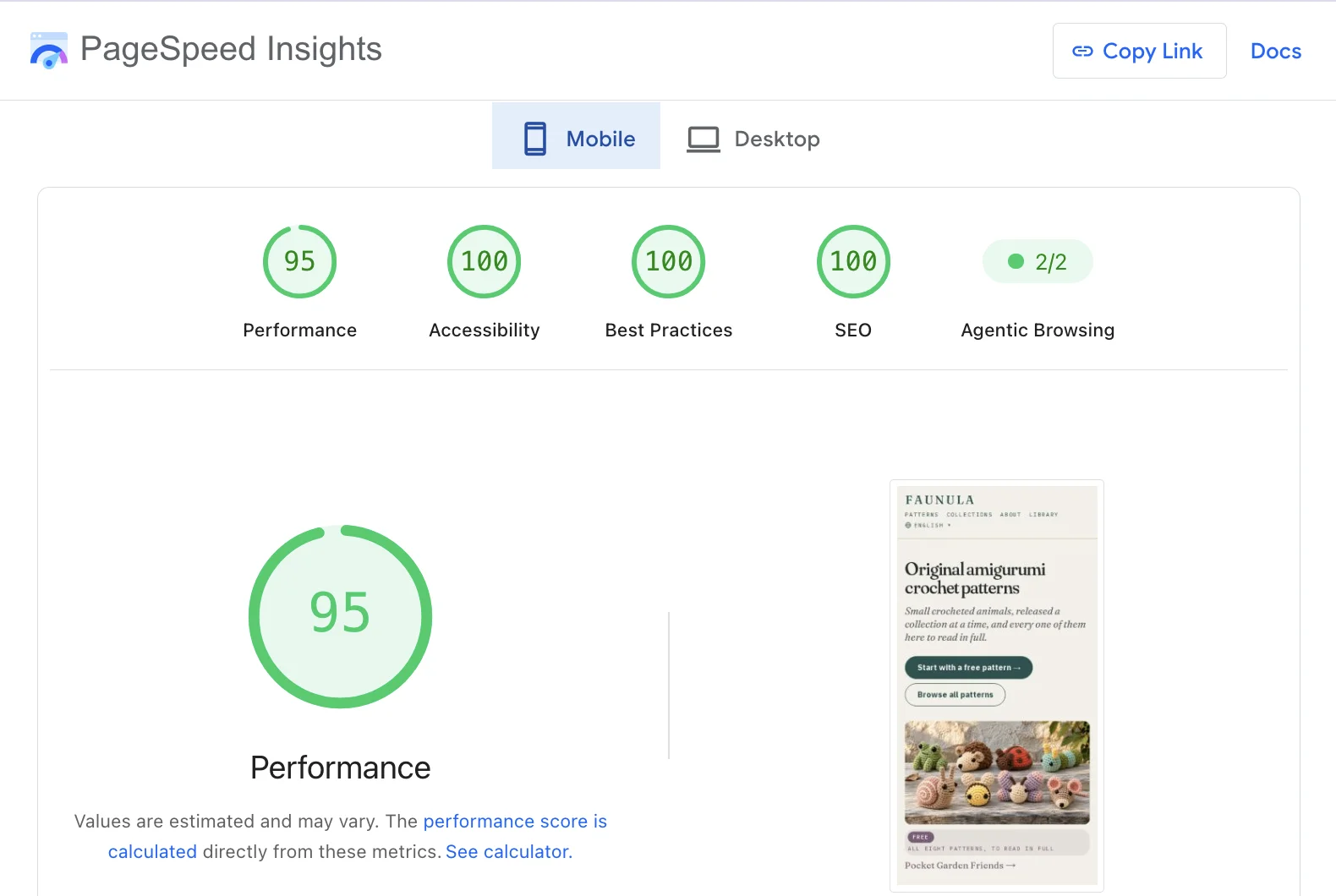
The result in Google’s PageSpeed Insights: the home page scores 100 in all four categories on desktop, and 95 for performance on mobile, with the other three at 100.
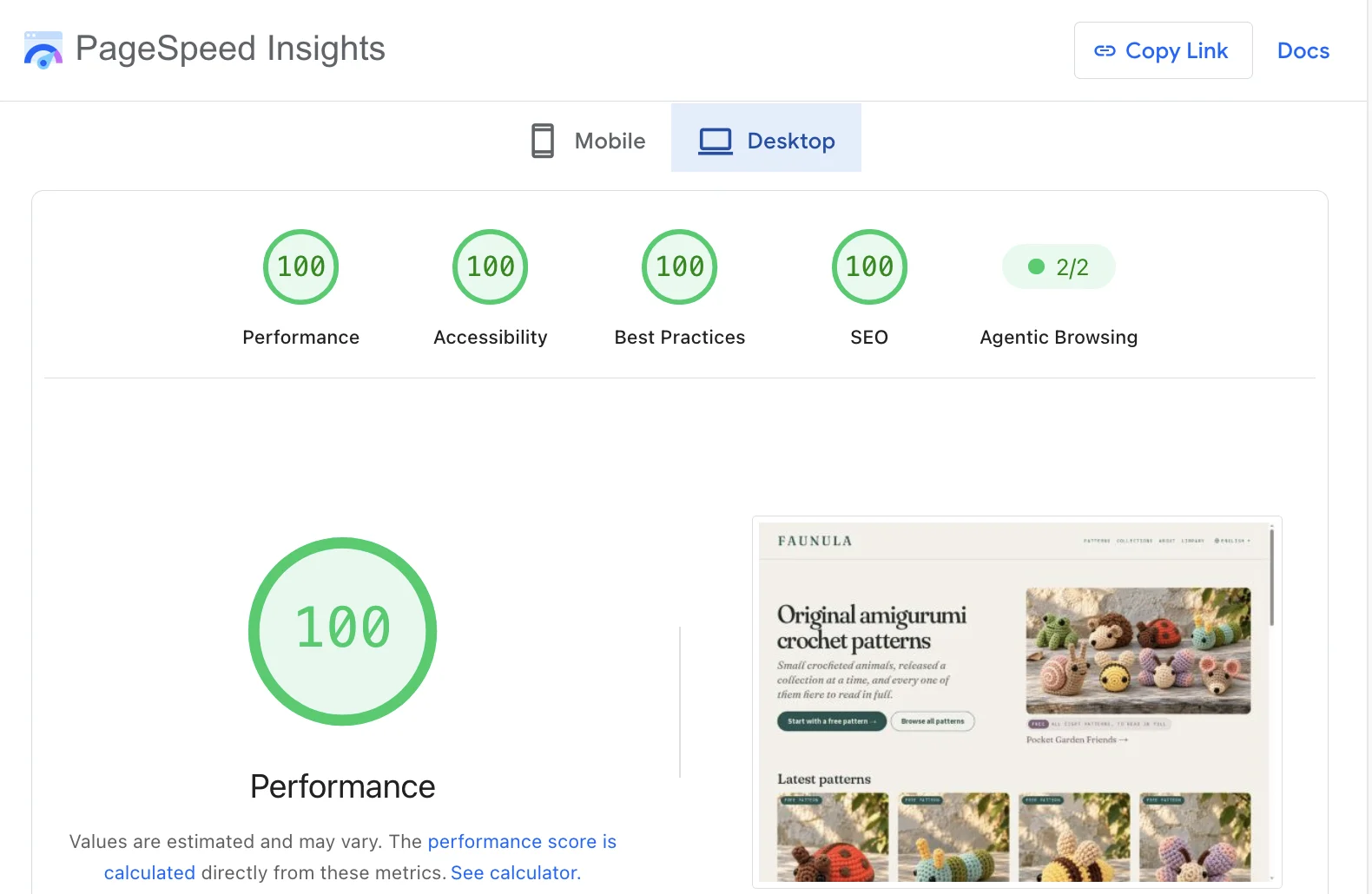
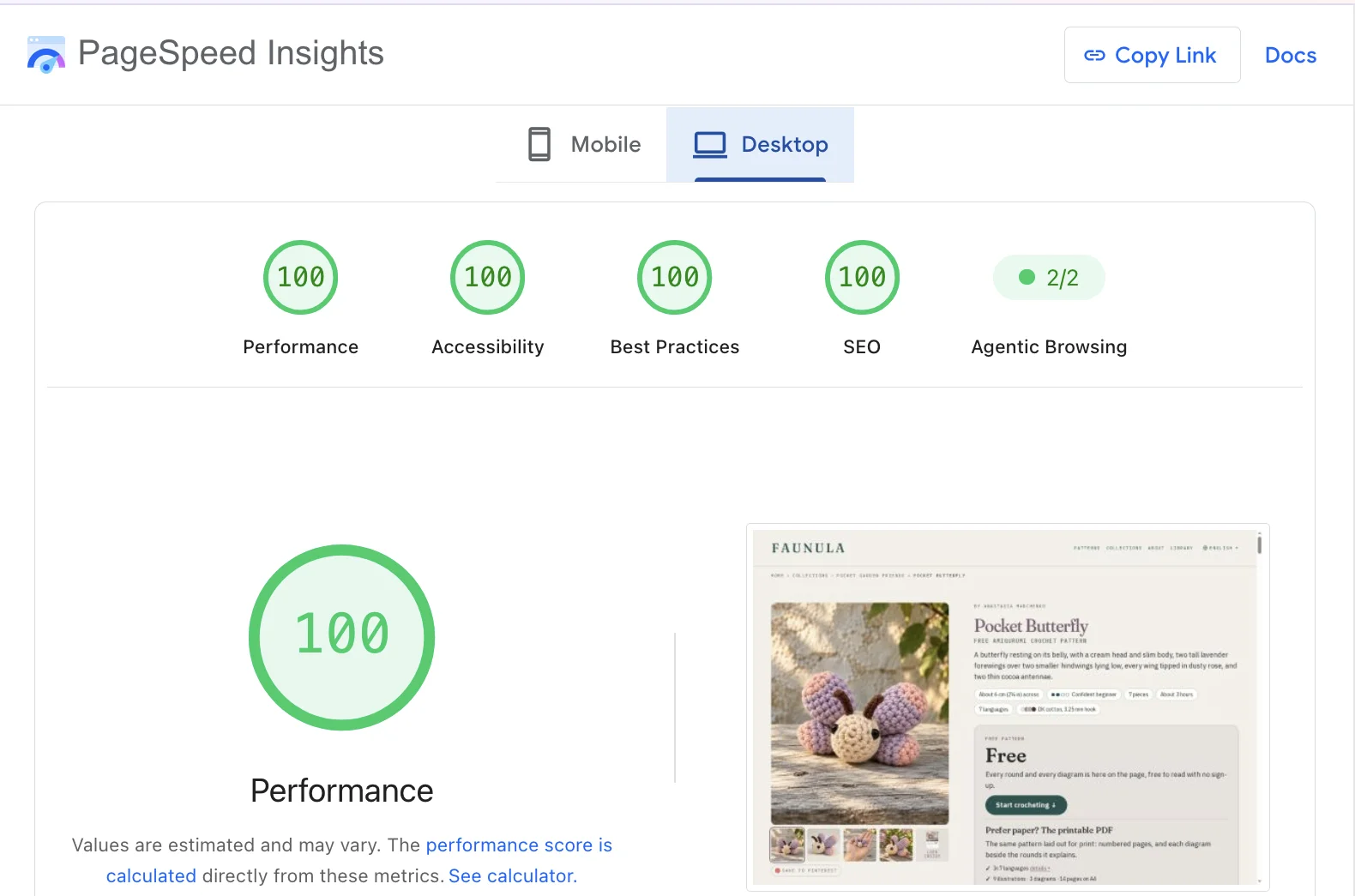
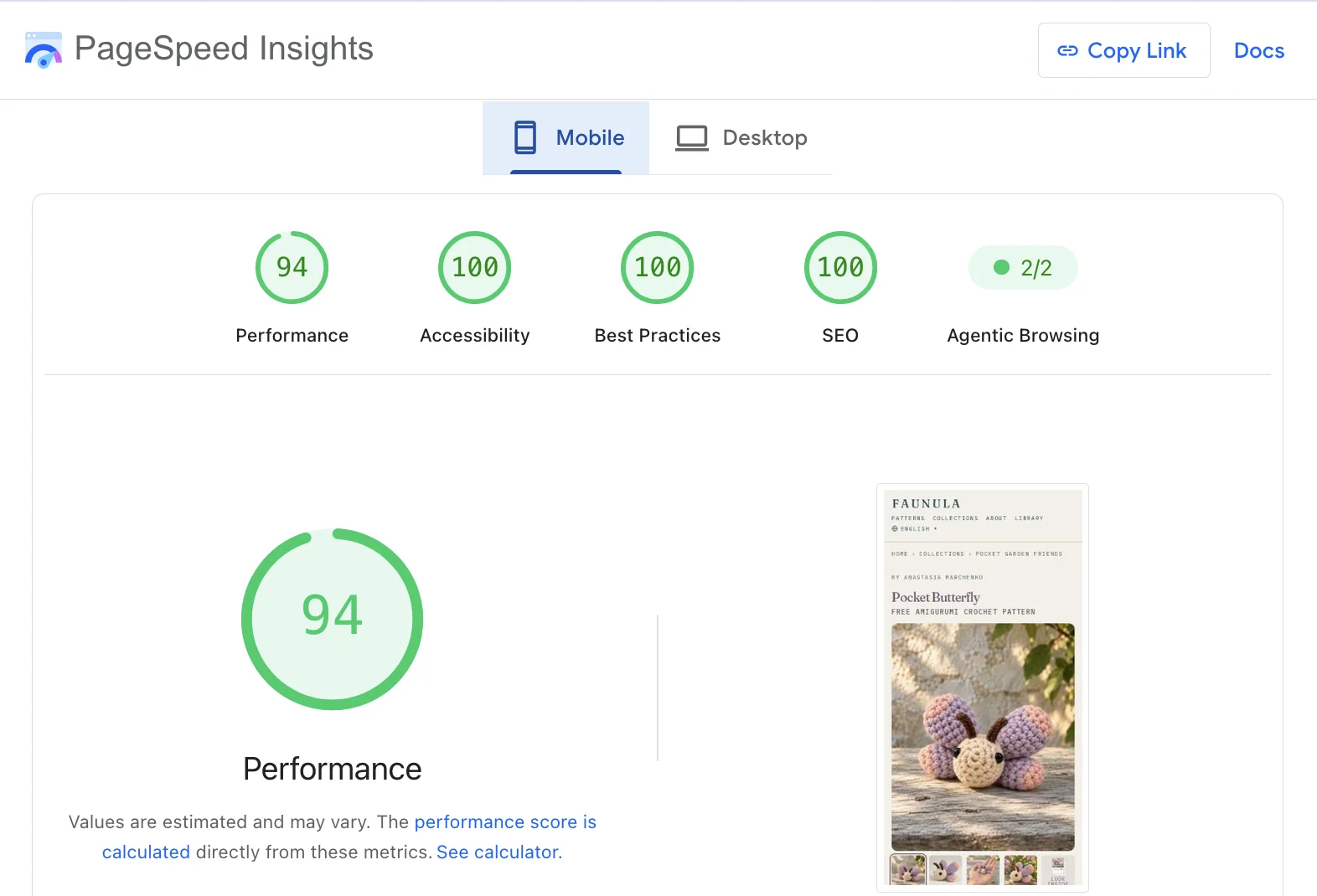
A pattern page is a heavier test, with a photo gallery, diagrams and the full pattern text. The free butterfly pattern page scores 100 in all four on desktop and 94 for performance on mobile.
It wasn’t like that from the start. On 2 October, a Lighthouse test of the English pages gave 78 to 81 on mobile, and the cause turned out to be fonts rather than photos: about 630 KB of them, loaded before anything else. What I changed:
- the page now preloads only the Latin characters of its two fonts, in the upright style;
- the heading font was cut down to the settings the design actually uses, which roughly halved its files;
- on phones, the gallery’s extra photos load after the page instead of with it.
The same test then gave 91 to 96. Lighthouse also suggested saving on images, but that meant giving up retina quality, so I didn’t take it. Since then I keep one rule: no change ships if any Lighthouse metric gets worse.
This isn’t only my site. In HTTP Archive’s Core Web Vitals technology report for September 2026, 71% of Astro sites pass Core Web Vitals on mobile, against 48% of WordPress sites. So almost half of WordPress sites pass too; a static site just starts from a faster default.
If you want a site like this
If it sounds complicated, find someone who will build it for you turnkey. If it sounds expensive, start with the basics; the site can grow with you.
It’s like crochet: you don’t need to know everything before your first stitch.
Serge and I build sites like Faunula for makers who sell digital patterns and other digital goods. If you’d like one, write to me at faunula.studio@gmail.com.
Anastasia designs amigurumi crochet patterns at Faunula, and builds fast, low-cost websites for makers who sell digital patterns and other digital goods.